
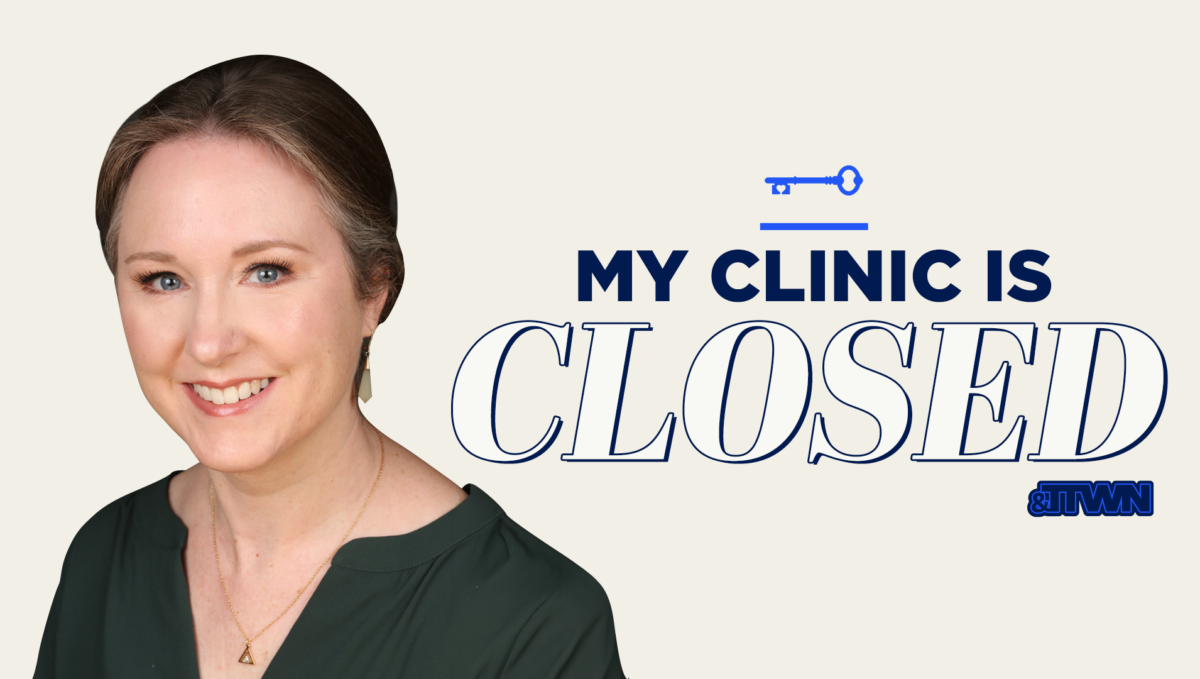
When Caroline Strzesynski became a nurse, she knew she wanted to work with women. She wanted to care for them, understand their needs, and build a career in women’s health.
But she had no idea where that desire would take her—or the countless ways God would intervene along the way.
Caroline was a new nurse when a friend who worked at a local abortion clinic invited her to shadow her for the day. She went simply to observe, and the nurse practitioner manager made it clear when she arrived that there was no job waiting for her.
“I filled out the paperwork I needed to fill out, and she said, ‘Just so you know, we’re not hiring,’” Caroline recalled. “So, I said, ‘Okay, I’m just here to shadow.’ But by the end of the day, I was hired, and I don’t really remember any more of an interview process. I just caught on to the recovery room quickly and was very comfortable in that setting, which is sad to say.”
Caroline became an abortion recovery room nurse at the Center for Choice, a private abortion clinic in Ohio. Later, she learned about Planned Parenthood and took a position with a local affiliate. That particular facility did not perform abortions, but it did provide abortion referrals.
As the years passed, Caroline continued building her career and eventually became a women’s health nurse practitioner. But her life outside of work was changing, too. She became a mother and a Christian. God was working on her. And those changes would eventually transform the way she saw the work she had once accepted so easily.
About a decade after she had last worked inside an abortion clinic, Caroline was the lead clinician at her Planned Parenthood facility when she was sent to a sister affiliate for training on Nexplanon, a contraceptive implant. She completed her training that morning but discovered that she would have to spend the afternoon in the abortion clinic, where she was expected to insert the implants for women following their abortions or during follow-up appointments.
The prospect of returning to that environment left Caroline unsettled in a way it never had before.
“That’s where I really started to wrestle and become uneasy because now I’m a mom, and I’m a Christian mom,” she said. “And I’m being asked to go back into the setting that I hadn’t been a part of for about a decade. And I just wrestled with it in my mind and really had to talk myself down to be like, ‘No, Caroline, you’re pro-choice. This is okay. You’ve been there. You’ve done this before. You’ve just got to do your procedures. You’re helping these women.’”
Caroline had spent years believing that last part—that she was helping women. It was the reason she had gone into nursing in the first place, and it was the explanation that had allowed her to remain comfortable with the work around her.
But when she walked back into an abortion clinic after nearly a decade away, all her senses were amplified again.
“Until you’re in it, you don’t know how much it affects all your five senses to some degree,” Caroline remembered. “And there I was in the midst of it all.”
Caroline soon saw three women preparing for their abortions, and at that moment, something inside her shifted.
“I remember looking at those ladies, and I just felt terrible. And I really felt God’s presence palpably with me. But I didn’t really know how to respond other than to pray for the ladies. But what I saw, I didn’t just see the women. I saw the life within.”
Caroline had spent much of her career focused on the woman in front of her. Now, for the first time, she could not separate that woman from the life growing inside of her.
“That’s something that hadn’t happened before that I wish had happened early on,” she said. “But it hadn’t until then. And I really became aware of the generational impact of it all at that moment.”
It was not an easy realization. Caroline was beginning to become pro-life while standing in an environment where almost no one around her thought the same way. She had years of assumptions to unravel, a career tied to Planned Parenthood, and a new faith that was forcing her to look at familiar things with different eyes.
That afternoon only deepened her uneasiness.
An abortionist was working with a resident, and although Caroline was outside the procedure room, she could hear the interactions and observe staff members as they came and went. From what she heard and from the reactions of the staff, Caroline believed the resident had been permitted to do more than he should have.
The staff members were visibly unhappy, and Caroline decided she had seen enough.
“I remember looking at my supervisor at that local affiliate there and saying, ‘I’ve seen enough, and it’s time for me to go.’ And she said she completely respected my decision,” Caroline recalled. “I thought only God could really coordinate that. And within 15 minutes, I was out of the building.”
Caroline had not performed a single one of the contraceptive procedures she had been sent there to do. But the day was not over.
On the drive home, Caroline asked the supervisor from her own affiliate what had been discussed during the managers’ meeting. Her answer was “Quotas.”
Caroline asked what kind.
“Abortion.”
Confused, Caroline wanted to know whether abortion numbers were going down. Her supervisor told her they were not.
“That’s not good,” she told her supervisor.
The response Caroline received exposed something she had never understood about the organization where she had spent so much of her career.
“Caroline, we don’t want the numbers to go down,” her supervisor said.
Caroline could not reconcile that statement with what she believed Planned Parenthood was supposed to accomplish.
“What do you mean you don’t want the numbers to go down? Isn’t that the point of what we do, to put ourselves out of business? You know, make contraception so available to everybody? At least that’s what we put out to the public.”
Then came the answer that changed everything.
“Abortion is how we make our money,” her supervisor stated.
Caroline was stunned.
“I just was floored that the mission I thought I had been working toward was not the mission I was working for. So, it was sad. Very sad.”
By the time Caroline returned home, the questions that had been growing in her heart were no longer questions she could push aside. She had seen the women waiting for abortions and, for the first time, recognized “the life within.” She had watched the discomfort of the abortion clinic staff. And now she had been told that the goal was not fewer abortions, but more.
“That was the end. That was it. I knew obedience, and I was like, I’m gonna be Jonah and the whale if I’m not out of here,” she said.
As a relatively new Christian, Caroline sought guidance from a local pastor about how quickly she needed to leave. Ultimately, Caroline gave six weeks’ notice and moved into another medical position.
But while walking away from Planned Parenthood was an important act of obedience, it was not the end of Caroline’s transformation.
For a time, she continued practicing women’s health in much the same way she had before, including prescribing and providing contraception. Eventually, while working in college health, she began seeing things that troubled her. Some young women were experiencing recurrent infections. Then, in two cases, Caroline attempted to remove IUDs but could not because scar tissue had adhered the devices in place, requiring surgical referrals.
She began thinking beyond what her patients wanted in that moment and asking what her care might mean for their fertility years later.
“I started to really think about what I was doing for their fertility long term. I know I’m fulfilling their desires right now, but what about when they actually want to grow a family?”
The question followed her home. Caroline remembers crying during the drive and talking with her husband about what she believed God was asking of her.
“I think God is calling me away from contraceptives altogether,” Caroline recalled telling her husband.
While he understood what that decision could cost, leaving Planned Parenthood had already created financial hardship for their family and cost them their health benefits. Now they had two children, and Caroline was considering another professional decision that could significantly reduce her work as a women’s health nurse practitioner.
Her husband told her he was not sure it was a good time.
Caroline answered, “Now is God’s time.”
Her husband responded, “I support you 100%.”
Once again, Caroline followed where she believed God was leading, even when she could not see exactly where she would end up.
She stopped practicing contraception and eventually trained in NaProTECHNOLOGY and Creighton at the St. Paul VI Institute in Omaha.
Today, Caroline works through MyCatholicDoctor, caring for women struggling with infertility or recurrent pregnancy loss and helping couples conceive and sustain pregnancies. Her work has also expanded into midwifery, where she participates in prenatal care and births.
The contrast with her former life is not lost on her.
“It’s a ministry now,” Caroline said. “So, it’s very different because you really are working with God. It’s very apparent, especially with birth. I mean, it’s such a miracle with labor and birth and just that whole journey with clients.”
For Caroline, that change didn’t happen overnight, and neither did her relationship with Christ.
“This journey has been such a long one, and He’s been so patient,” she said.
Caroline had grown up attending church with her family, but fell away during college. Years later, motherhood and the difficulties she experienced while working at Planned Parenthood helped draw her back. She found a church and began attending by herself, even though her husband and friends did not share her renewed interest in faith.
Then, she began reading the Bible voraciously. And when a pastor encouraged those who wanted to know Jesus to read the Gospel of Matthew, Caroline did.
“When I read the Gospel of Matthew, that just really brought Jesus to life for me. And my belief was solid then,” Caroline said.
At that point, she dedicated her life to Christ. In time, her husband became a believer as well, and Caroline’s continuing search for truth eventually led her into the Catholic Church. But there was still a part of her past that she had never fully processed.
The same pastor Caroline had spoken with when leaving Planned Parenthood eventually connected her with Savannah Martin, the CEO of a local pregnancy center. After nearly 15 years with Planned Parenthood, Caroline had heard plenty of negative messages about pregnancy centers. But what she actually found when she finally walked into one astounded her.
“It was so fabulous,” Caroline said.
She saw the services being offered, the quality of care, and the genuine support available to women. Yet as her assumptions about pregnancy centers began to fall away, shame over her own past took their place.
“I mean, I thought, my gosh, if she knew my background, she would not even want me here,” Caroline remembered. “It went from me not believing I’m even walking into the facility to feeling so dirty that I didn’t belong.”
Then Caroline said something that captures so much of her journey.
“But I did belong. God knew I did.”
Savannah listened to Caroline’s story and loved her anyway. Then, she asked Caroline if she had ever heard of Abby Johnson.
She had not.
Abby was scheduled to speak at the pregnancy center’s fundraising gala just two weeks later, and that connection eventually led Caroline to And Then There Were None. Within about a month, she attended her first healing retreat.
By then, years had passed since Caroline had directly participated in abortion work. She had spent time dealing with that past privately with God, but she had never really had a place to talk openly about it with people who understood.
“I hadn’t really spoken to anybody because nobody’s gonna understand you,” Caroline said. “Being in a space where you could talk with other people, experience the same things, and work through that and heal from it, that was a game changer.”
The retreat was challenging for Caroline. She and the other former abortion workers confronted their culpability and the sheer number of deaths connected to the work they had once done. But for Caroline, it became another part of a healing journey God had already been guiding for years.
It also gave her a community.
The bonds between former abortion workers can be difficult for outsiders to understand, and their relationships can become extraordinarily deep. For Caroline, one of those relationships eventually led her to donate a kidney to another Quitter named Shelley.
The two women lived in different states and did not know one another particularly well when Caroline learned that Shelley needed a kidney. But after discovering she was a match, Caroline decided she would donate.
It’s an extraordinary picture of what life after the abortion industry can become: two women once connected to an industry that ends lives, now connected through an act that helped save one.
And Caroline’s story would eventually come full circle in another way.
The Center for Choice, the private abortion clinic where Caroline had first worked as a young nurse, closed years after she left. Caroline does not know the exact circumstances of the closure, though she believes the clinic had difficulty securing a transfer agreement with a local hospital.
She learned the news through Savannah—the same woman who had welcomed her into the pregnancy center and helped connect her with Abby.
But the building’s story did not end with an empty abortion clinic. A memorial to the unborn was established there.
“It was turned into something life fulfilling rather than death,” Caroline said.
And there’s something fitting about that transformation because it mirrors Caroline’s own.
The young nurse who once helped women recover after abortions now spends her days helping women understand and care for their fertility. She works with couples longing to conceive, mothers trying to sustain pregnancies, and families welcoming children into the world. She has stood beside fathers as they caught their babies and has watched couples she cared for finally become parents.
“Everything now is life-focused. Everything is about teaching women about their body and their fertility on any given day,” Caroline said.
For a woman who has always wanted to help other women, it’s become her new life mission—a vision of women’s healthcare that works with a woman’s body rather than against it and recognizes the life within a mother as someone worthy of protection.
“So much of women’s health you don’t even realize,” she said. “It’s almost like NaProTECHNOLOGY and Creighton are these really well-kept secrets somehow. But there is this really wholesome way to deliver health care and help couples and women…. So, it’d be great if we can sway somebody to not go into the abortion industry and instead go on the side of life.”