
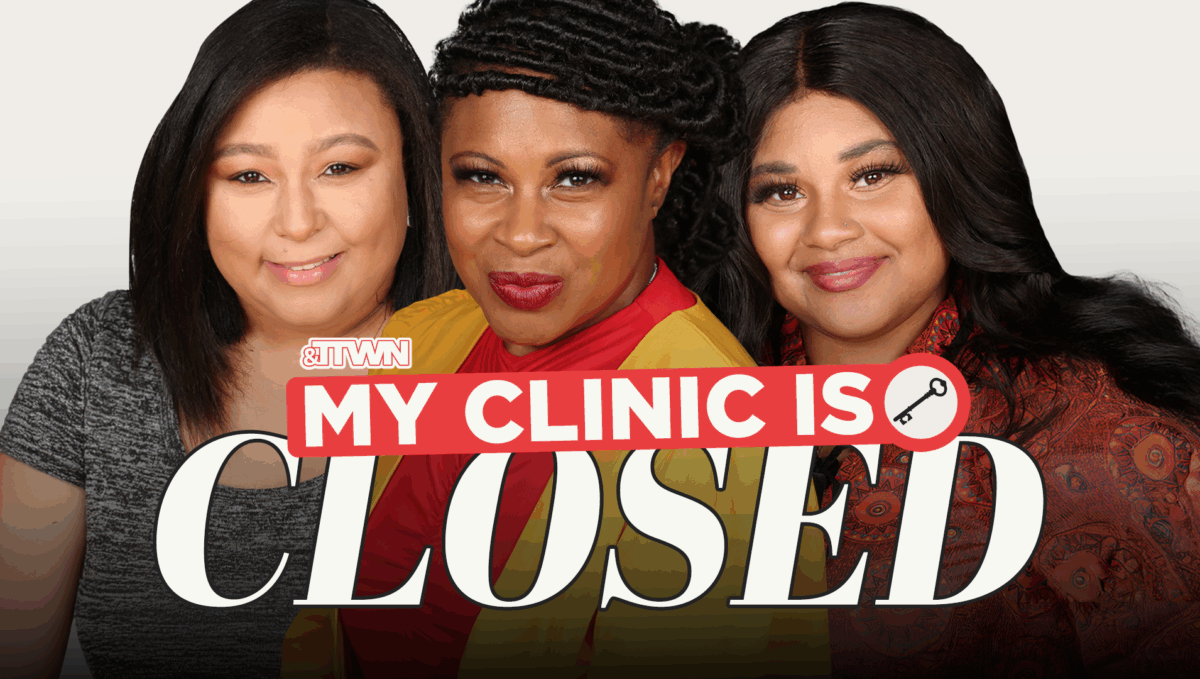
There’s something powerful that happens when women share a bond with each other—even if that connection comes amidst some of the most painful, traumatic, or crazy circumstances three people could ever experience together. Such was the case for Alicia Davis, Vanessa Thompson, and Kiah Amaya.
In need of work for various reasons, these three women of different backgrounds and personalities found themselves working together in the abortion industry at the infamous Family Reproductive Health—an abortion clinic in North Carolina that is now permanently closed. With a gregarious spirit and prior experience working at an abortion clinic, Alicia served as the manager while the quiet and more reserved Kiah worked as a receptionist to make appointments, give patients their paperwork, and take phone calls. Vanessa, who had only ever worked in the medical field up until that point, brought her steadfast personality to the front desk, but she quickly learned that wasn’t all she would be doing.
“I was hired for the front desk, but I didn’t have a specific role. My job felt more like, ‘Vanessa go here and then go here,’” she recalled. “So, I just migrated around everywhere. I don’t even think that the owner created a specific job title for me.”
The chaos of uncertain job responsibilities can be difficult enough to navigate, but it was just the tip of the iceberg for the team as they came to understand that “crazy” was at the heart of the clinic’s culture. Owned by Deborah (Deb) Walsh, things around the abortion clinic got weird. After a previous manager quit, Deb had stepped in to run things, but her style was not only unorthodox, it was also downright bizarre.
“The owner had a house that was over an hour away and often decided to sleep in the clinic,” Kiah remembered. “She had an actual bed in there, not a fold-out couch, an actual bed. She had a TV mounted on the wall and a little griddle to cook food on. She would primarily stay up at night and then sleep during the day while we worked there. She basically took over one of the rooms at the clinic and made it her own—right beside the patient waiting area.”
In addition to making the abortion business her living quarters, Deb also kept a shotgun with her and even used it to intimidate some peaceful protestors.
“One time, there was this older man, very quiet, just praying outside the clinic. Deb came out from her room where she lived in the clinic with her shotgun and went to stand next to the man. I still have that picture,” Vanessa explained.
Alicia also had a frightening experience with the shotgun.
“I remember one office day, another co-worker and I heard a gun go ‘click click,’ and we were like, ‘what in the world?’ So, we went running to this door, shouting, ‘Deb, we’re in here. It’s us. We’re in here.’ It was broad daylight, but Deb didn’t know what was going on,” she recalled.
On another occasion, Deb had just hired a bunch of new people. She was outside cleaning the grounds around the clinic when she found a pill bottle with some marijuana in it. Deb brought the bottle into the front office, and instead of getting rid of it, she told her employees that if anyone wanted to take it, they could.
“All the new hires were like, ‘is she serious?’ And I was like, ‘unfortunately, yes, she is,’” Kiah shared.
But if sleeping at the abortion clinic, a shotgun on the premises, and drugs offered to her employees weren’t enough, somehow Deb found a way to top this level of crazy.
“There was one time when I saw her naked,” Alicia laughed hysterically. “That was horrible. I opened up the building, so she knew I was in there. So, I’m cleaning up, and of course, she sleeps there, and she opens the door. She says, ‘Good morning!’ And she was butt naked. I’m like, ‘Do you want me to get you a towel?’ And she was just standing there, having a conversation with me.”
While Deb’s craziness was on full display, there were plenty of other red flags that alerted Alicia, Vanessa, and Kiah to the fact that they were on a sinking ship. The women witnessed Deb misrepresent herself as a nurse, facilitate abortions for minors without parental consent, and text consent information to women seeking abortions when it is required to be given verbally by a registered nurse or physician within 72 hours of the procedure. Deb even once tried to get a few other nurses to take the LPN exam for her so that she could regain her license, but they refused.
All of this eventually came to a head during the COVID pandemic. Deb moved out of the clinic, would only communicate by phone, and left her employees to fend for themselves.
As Kiah recalled, “We didn’t think the clinic should have been open. I think where we were, everyone was supposed to be in quarantine unless you were an essential worker. And we didn’t feel like the abortion clinic was an essential thing that needed to be open. Of course, Deb argued with us about that. And eventually, she quit responding to our concerns.”
“It just felt like she wasn’t protecting us as her employees,” Alicia shared. “Every time I asked her a question, she would talk in circles with a different answer to my question. So, I got teed off, and I was like, ‘You know what? I’m not doing this. I’m leaving.’”
With that, Alicia quit right in the middle of the day, and Family Reproductive Health began to unravel immediately. Knowing that Deb would just expect everyone else to pick up the slack without hiring more people, Kiah and Vanessa could see the writing on the wall. They both finished their shift and left for good.
But that wasn’t the end for these three fearless women. The bond between them—and the power of such a connection—was just getting started. Soon after they quit, Alicia, Vanessa, and Kiah filed a nursing board complaint against Deb—motivated by their shared concern for public safety.
“If you want to operate as a clinic, you should follow the standards of every other clinic. But Family Reproductive Health wasn’t doing things the proper way,” Vanessa said. “And if you’re not caring for the people who are here day in and day out, you don’t care about public safety.”
While their effort was admirable, the complaint wasn’t taken seriously. The board took no action against Deb, but that didn’t stop the clinic from closing. After the three women walked out on the same day, Family Reproductive Health was left with just one employee, in addition to Deb, and that makes it hard to keep an abortion clinic running. Deb tried to pull in some clinic escorts to help out—volunteers who help patients get into and out of abortion clinics. But that didn’t work, and the clinic eventually closed because no one wanted to work there anymore—one of the key reasons why And Then There Were None exists.
As Vanessa recalled, “I feel like once we all left at the same time, she didn’t have another choice. Usually when someone leaves a business, you still have your current employees and can go out and find others. But when everybody leaves at the same time, it sinks the ship. You can’t remedy that, especially if you’re a crazy person like Deb. It’s very difficult to find people who will actually stay and work for you because, I can honestly say, Deb wasn’t the reason I stayed there. I think Kiah, Alicia, and everybody else in the clinic were the reason I stayed.”
The other women agreed.
“I can agree with that,” said Kiah. “It was more for me about my coworkers, the people that I work with. I didn’t stay there because I was passionate about the cause or anything.”
“We were a good team. We were a good team,” said Alicia.
When news of the clinic’s closure reached the women, they each had their own unique reaction.
“I heard about the clinic closure from And Then There Were None,” Alicia recalled. “And I thought, ‘wow!’ I just thought it was going to continue to stay open because Deb loved that place. I could never see her giving up on it.”
“I was a little shocked,” Kiah said. “She had offers to buy it, even from one of her clinic escorts. But she turned down the offer, so I assumed that she was trying to stay there forever.”
Vanessa felt different.
“Honestly, I really didn’t know how to feel. I was going through the motions of COVID, and it was just a very rough time during that period. It was very rough for me. But I was just like, ‘Okay. That’s what she gets.’”
Mixed feelings after such traumatic experiences are certainly understandable, but that’s why these women have made it a point to stay connected. While they have kept in touch with a few of their former co-workers after leaving Family Reproductive Health, their bond is tightest with each other. Alicia, Vanessa, and Kiah stay in contact regularly, though life gets busy sometimes. And it’s this bond that not only helped them to bring down the abortion clinic, but it’s what’s helping them experience joy, find healing, and grow spiritually—though that’s not always easy.
“Me and Christ, we’ve been having our ups and downs,” Alicia said. “I most definitely believe in God, always, 100%. But sometimes, my faith isn’t where it needs to be.”
Vanessa felt similarly, “My faith is up and down, but I do talk to God every single night. I do say my prayers every night. I just don’t go to church. But I know God’s working on me every single day.”
Despite being shy and more reserved, Kiah has been getting more involved at church.
“As Alicia and Vanessa know, I just like to hide in the corner. But since leaving the abortion clinic, I’ve been a little more open with sharing about my time there with church members,” she said. “And I have been more involved in church with the children’s ministry and helping to set up and take down things on Sundays.”
The women also have mixed feelings when it comes to how they’ve seen God’s hand moving in their lives now—along with how He was moving during their departure and the clinic’s eventual closure.
“At the time I left the clinic, I didn’t feel God’s hand moving, but the day I came back and dropped those keys off, I felt so much lift up off my shoulders,” Alicia shared. “I just kept walking, didn’t even look back. It was like I was out of jail.”
Kiah has seen a more gradual change in her life.
“Like Alicia said, I didn’t feel a change right away,” she said. “But I guess I feel like life has just gradually gotten better. I didn’t always see it like this, but the more I talked with my husband about it, he pointed things out to me that I didn’t even realize.”
On the other hand, Vanessa has struggled to see how God has been working through this experience.
“With my personal experience, there are certain things that I wanted to accomplish as a woman, and I felt that God has been punishing me for working in that place,” she said. “It was a great thing that I left, but I’ve had trouble getting pregnant since then. So, I haven’t felt this big weight come off of me.”
At the same time, Vanessa recognizes that there’s more to come.
“I feel like if I can move past this, and I can talk about it, at one point, I will learn to deal with the idea that I’m not being punished,” she continued. “And maybe God’s rejection is really just God’s protection. So, maybe I just need to learn to not be so hard on myself and understand that I do deserve God’s forgiveness. It’s just a learning process and something that I have to go through every single day.”
All of this is to be expected. Healing from the trauma of the abortion industry can take time, especially when dealing with an eccentric owner like Deb. But that’s why ATTWN stays committed to walking the journey of healing with each Quitter. And that’s something all three women have noticed.
“Working with ATTWN is fantastic,” Alicia exclaimed. “They keep checking on you to see if you want to be involved in certain things. They don’t forget about you.”
Kiah added, “They really care about you, and they’ve created a space where former abortion workers can just get together and care about each other. It’s so genuine.”
Vanessa agreed, “We love on each other. And it doesn’t matter where you’re at, we will come to support each other when the time is needed.”
While all three women are at a different place in their spiritual journeys, they agree that they would love to do their part to see even more abortion clinics close. And each of them would tell anyone still working in the abortion industry today, “It’s not worth it.”
For now, these three courageous women, bonded together under some of life’s most traumatic and unusual circumstances, are hoping their story can impact others.
“I hope our story shines a light onto the reality of abortion because I don’t think too many people really understand it,” Alicia said. “They don’t know what actually takes place in an abortion clinic, and I think by shining a light on it, we can help out a lot more people in this world.”
Vanessa added, “And just to tag on to what Alicia said, when I first got pregnant before all this, I didn’t want kids. But God had divine intervention because me and my mom have the same number, and the doctor accidentally called her to tell her that her prenatal was ready. But I had planned to go right down to that clinic if it weren’t for that divine intervention. Now, I want young women to know that they have other options. Abortion is not the only option. I am living proof, and there’s no excuse. If you’re a single parent who’s working or in school, you can do it.”
Nodding along in agreement, Kiah concluded, “It took a really long time to share my story because I worked at the front desk, so I didn’t really feel like I had a story to share. But I’m hoping that even if you have a smaller role, even if you don’t go in the back, even if you don’t see what is actually going on at your abortion clinic, you can still get out. You need to get out.”