
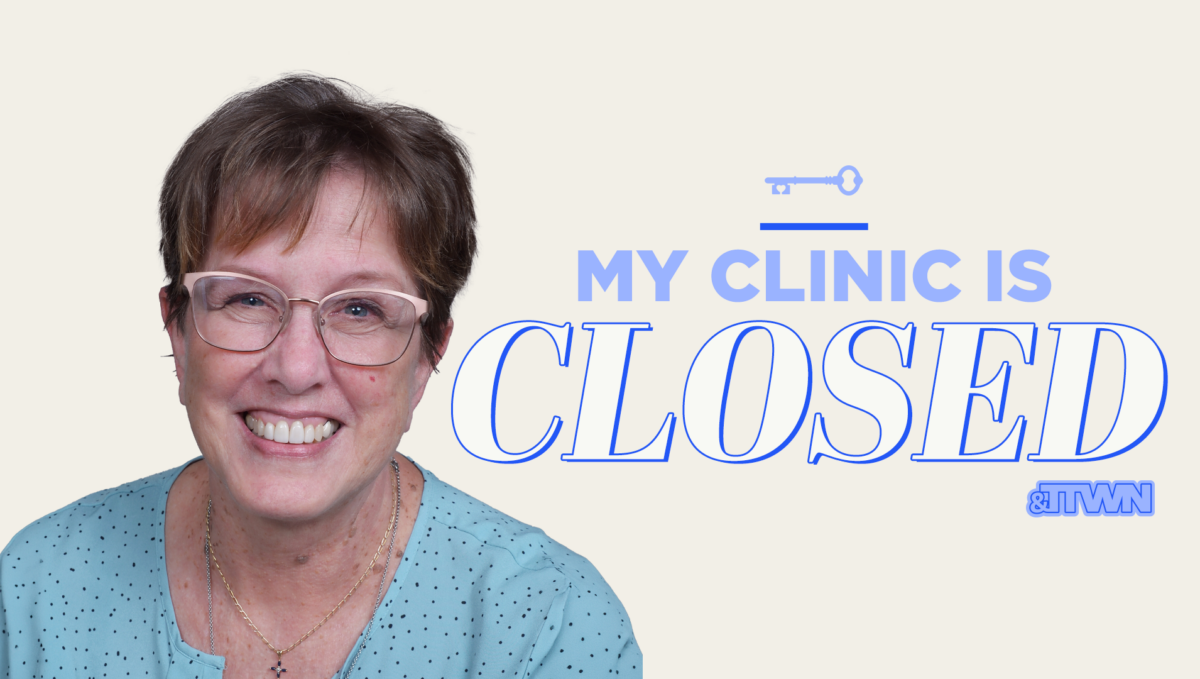
Long before Kris McCarthy ever stepped inside an abortion clinic as an employee, she was a young woman searching for love, belonging, and a sense of purpose. She could never have imagined where that search would lead her, or how many years it would take to find the peace her heart had been longing for.
Kris grew up in Ann Arbor, Michigan, as the seventh of eight children in a Catholic family. Her childhood included Catholic school and church services on Christmas and Easter, but faith was not something she understood on a deeply personal level. Although she knew about God, she had not yet discovered what it meant to have a relationship with Him.
“We all had family dinner together at a dinner table back then,” she recalled. “But there was never a prayer time. There was never any kind of time to get into the Bible, talk about biblical things.”
When Kris transitioned to public school in the early 1970s, her life began moving in a different direction. Around that time, she remembers seeing graphic images of aborted children displayed by a pro-life organization at a fair.
“I thought, that’s awful. How could anyone do that? I could never do that,” she said.
As Kris grew older, she found herself becoming more worldly and searching for something she could not quite identify.
“As I became older and was so lost in a world wanting to fill that hole in my soul, I turned to drugs initially, using LSD, marijuana,” she remembered. “And then when I got old enough to legally purchase alcohol, that’s what became my idol for a long time.”
As alcohol took over her life, so did unhealthy relationships and other choices that brought lasting pain. Kris became a mother to a son she loved dearly, but she also experienced two abortions and a miscarriage.
Wanting to provide a better future for her son, she decided to pursue nursing. Eventually, she moved from Michigan to North Carolina, hoping a change of scenery might offer the fresh start she needed.
After briefly working at Duke University, Kris answered an advertisement for a nursing position at Raleigh Women’s Health Organization, an abortion clinic. Having experienced abortion herself, Kris believed she could relate to women facing unexpected pregnancies.
But before accepting the position, she was required to observe an abortion. On this particular day, the patient was a married woman who had struggled for years to conceive, only to receive a breast cancer diagnosis after becoming pregnant. According to Kris, the woman had been told abortion was her only option.
“It was just heartbreaking to watch her,” she said.
As Kris witnessed the woman’s devastation, she chose to focus on the medical aspects of the procedure rather than questioning what was taking place. She accepted the job on that day in 1992.
During the nearly eleven months she spent there, Kris became familiar with the daily routines of abortion work.
After abortions, the remains of the unborn children were examined in the laboratory. Kris knew what took place there, but she could not bring herself to watch.
“I knew what was going on in there, but I just wouldn’t look. I just couldn’t look,” she said.
During one procedure, Kris witnessed something that would remain with her for years. After an abortion, she was carrying the suction canister while the doctor carried the surgical tray. As they left the room, the doctor looked at her and then glanced down.
“When I looked down, I saw a little beating human heart next to a mutilated body and the tools that killed it,” she remembered. “That night was rough. Man, was I drunk that night.”
There were other moments inside the clinic that Kris would never forget, including one involving a woman who came in seeking an abortion.
Because the clinic’s regular ultrasound nurse was away, Kris performed the scan. She noticed what appeared to be a multiple pregnancy and asked the doctor to confirm what she was seeing.
The woman was carrying twins.
As she shared the news, Kris remembers the patient sitting quietly for a moment before responding.
“I could kill one, but I can’t kill two.”
The woman decided not to proceed with the abortion, and Kris never learned what became of those children. But she still thinks about them.
“Those babies now would be like what 34, 35 years old,” she said. “I often kind of wonder about them.”
Although memories like this stayed with Kris, her decision to leave the abortion clinic was not initially motivated by a change in her beliefs about abortion. At the time, she was involved in an abusive relationship that had become dangerous for both her and her son. Eventually, she knew she needed to escape.
“The relationship I was in was getting more and more violent, and I knew if I didn’t leave I would not survive,” she said. “So, that’s pretty much what got me out of there.”
Kris left North Carolina and returned to Michigan, but she feared encountering her abuser again. A travel nursing opportunity eventually brought her to Miami, Florida, where she continued her career.
In Miami, Kris worked with cancer patients, often witnessing families confront heartbreaking decisions. One experience brought back memories of the woman with breast cancer whose abortion she had observed when she first started working at the abortion clinic.
On this particular occasion, a pregnant woman receiving oncology care had been diagnosed with cancer and offered an abortion. But despite the risks, she and her husband decided to continue the pregnancy. The baby was delivered prematurely, and the mother was able to meet her daughter before she died.
Years later, Kris unexpectedly encountered the woman’s husband in a supermarket. He recognized her and shared that their daughter was doing well.
That encounter meant a great deal to Kris. She had witnessed the family’s suffering, but she also had the opportunity to hear about the little girl who was growing up because her parents had chosen to continue the pregnancy.
As Kris continued working in nursing, she also began confronting her own struggles with alcohol, regret, and the direction her life had taken.
For years, she had questioned God’s goodness in light of everything she had experienced.
“I had this feeling that if God is so good and loving, why is my life just in such a shambles?”
Working in oncology and later hospice care brought Kris into contact with people facing death and searching for answers about eternity. Their questions often stirred questions of her own.
At the same time, recovery from alcoholism was changing her perspective.
“As I became more sober, physically sober, it started leading me down the path of emotional sobriety, which led me toward God,” she said. “And it’s amazing what he’s allowed me to see.”
Kris remembers September 30, 2006, as a significant turning point in her spiritual journey. She began recognizing what she believed was God’s invitation to know Him personally.
Over time, she started attending church, studying Scripture, and developing relationships with other believers. She spent five years studying the Gospel of John with a close friend, gradually building the foundation of faith she had never experienced as a child.
Yet even after coming to know Jesus Christ, Kris struggled to fully accept His forgiveness.
She believed God could forgive every sin, but when she thought about her own abortions and the work she had done inside the clinic, she found it difficult to extend that truth to herself.
Through Bible study and relationships with other Christian women, Kris began to experience a deeper understanding of God’s grace.
“I knew the Lord loved me. I knew He forgave every sin, but I kept holding on to my abortion sin,” she recalled. “And it was in this Bible study that I was able to really feel the love and forgiveness of Jesus.”
That journey eventually brought her into a community of people who understood her experiences in a way few others could.
In 2018, while attending a women’s Bible study at Calvary Church, Kris met a woman named Ruth who shared her own experience with abortion. Afterward, Kris approached her and opened up about her past. The following week, Ruth returned with a copy of Unplanned by Abby Johnson.
As Kris read the book, she discovered an invitation from Abby encouraging current and former abortion workers to reach out. Kris decided to contact her and was surprised when Abby responded personally.
“I received an email from Abby, not a form letter, but an actual email,” she recalled.
That exchange marked the beginning of Kris’s relationship with And Then There Were None (ATTWN), where she would eventually find a community of former abortion workers who understood her experiences.
In 2024, she attended a Healing Foundation gathering, where she met her ATTWN client advocate, Sarah Taylor, in person.
Kris describes herself as introverted, and opening up to new people has never come easily. But Sarah became someone she could trust, especially when Kris learned painful new information about one of her own abortions from years ago.
“I found out recently on my second abortion that I delivered a baby at home and it was a twin,” she said. “And that was because they didn’t do an ultrasound. So, I had no idea I had a twin pregnancy.”
Overwhelmed with grief, Kris called Sarah.
“I remember calling Sarah and just crying on her shoulder on the phone.”
Having spent years caring for hospice patients, Kris understood how important it was to allow someone to grieve without trying to fix their pain.
“Sarah never said, ‘It’ll be okay.’ She just knew what I needed,” Kris recalled.
Through Sarah and the other Quitters she met, Kris found a community where she could speak honestly about her experiences without fear of judgment.
“We don’t have to pretty it up for each other. We can just be honest and tell our stories and how it’s affected us and what we’re doing now after we’ve left.”
That freedom to be understood has become an important part of Kris’s healing. She no longer has to carry every difficult memory alone, and she has discovered that even the most painful parts of her story can help someone else.
As Kris reflected on her time in the abortion industry, she also became curious about what had happened to Raleigh Women’s Health Organization after she left.
“I Googled it, and what I found was it closed I think in 1996, but I couldn’t find out why,” she said.
Kris never discovered what caused the clinic to close. But knowing that the place where she had once participated in abortions was no longer operating brought her a sense of relief.
“I just remember smiling,” she said. “For whatever reason it closed, I’m just grateful because it’s saving so many lives.”
During a healing exercise, Kris had been encouraged to estimate how many abortions she had participated in while working at the clinic. When she calculated the number, she was overwhelmed.
In less than a year, she estimated that she had been involved in approximately 7,000 abortions.
“When I think about those 7,000 babies, they are connected to a mom and a dad and then grandmas, aunts, uncles, siblings,” she said. “It just blows my mind that one person, in less than a year, had an effect on that many lives.”
For Kris, that realization brought a deeper understanding of the far-reaching impact of abortion. She thought not only about the children whose lives had ended, but also about their mothers, fathers, and extended families. And while she knows that the closure of one clinic cannot eliminate every circumstance that leads a woman to consider abortion, she believes it can still make a difference.
“Having one less place to go might be the tool that changes their mind, you know?”
Today, Kris’s life looks very different from the one she was living when she first entered Raleigh Women’s Health Organization.
She is retired from nursing and continues growing in her relationship with Christ. She serves on her church’s prayer team, studies Scripture, and gathers with other believers. She and her husband, Bill, also host a Sunday evening small group.
Outside of her church activities, Kris volunteers at Queen City Pregnancy Resource Center, where she met a young single mother who reminded her of herself years earlier. Wanting to help, she offered to care for the woman’s son, babysitting him several days a week during the first year and a half of his life.
That relationship has become a special blessing for Kris. The little boy reminds her so much of her own son at that age, bringing back memories of the years when addiction and personal struggles made motherhood difficult.
“It’s kind of bittersweet. I was so broken back then. Look at what I missed. But the sweet part of that is the Lord is still using me.”
That understanding has become central to how Kris sees her life.
She often reflects on 2 Corinthians 1:3–4, which speaks of God’s comfort in times of trouble and how that comfort equips us to help others who are suffering.
“God in his wisdom knew what I needed,” Kris said. “And he led me on a path of recovery and redemption where today I’m not proud of the things I did, but you know what? He uses all that stuff so I can help somebody else just like me. What a gift.”
Kris knows she cannot change what happened during her time in the abortion industry, but she can use her experiences to encourage someone who is still there.
“There is a way out. You do not have to feel stuck there. There’s life after leaving that clinic.”
Now, she hopes her testimony will remind other workers that they do not have to remain defined by the choices they have made or the work they have done.
“You don’t have to live with this dark, dirty secret in your life,” Kris said.
More than three decades after leaving Raleigh Women’s Health Organization, Kris can look back with gratitude for the life God has given her. She still carries memories of the clinic, but she also carries the comfort of knowing she has been forgiven, the friendship of people who understand her, and a renewed purpose in helping others.
Her former clinic is closed, and she is grateful that no more abortions are taking place there. But perhaps the most meaningful part of Kris’s story is what God has done in her own life since she walked away. The woman who once searched desperately for something to fill the emptiness in her heart has found hope in Jesus Christ, and she now has the opportunity to share that hope with others.