
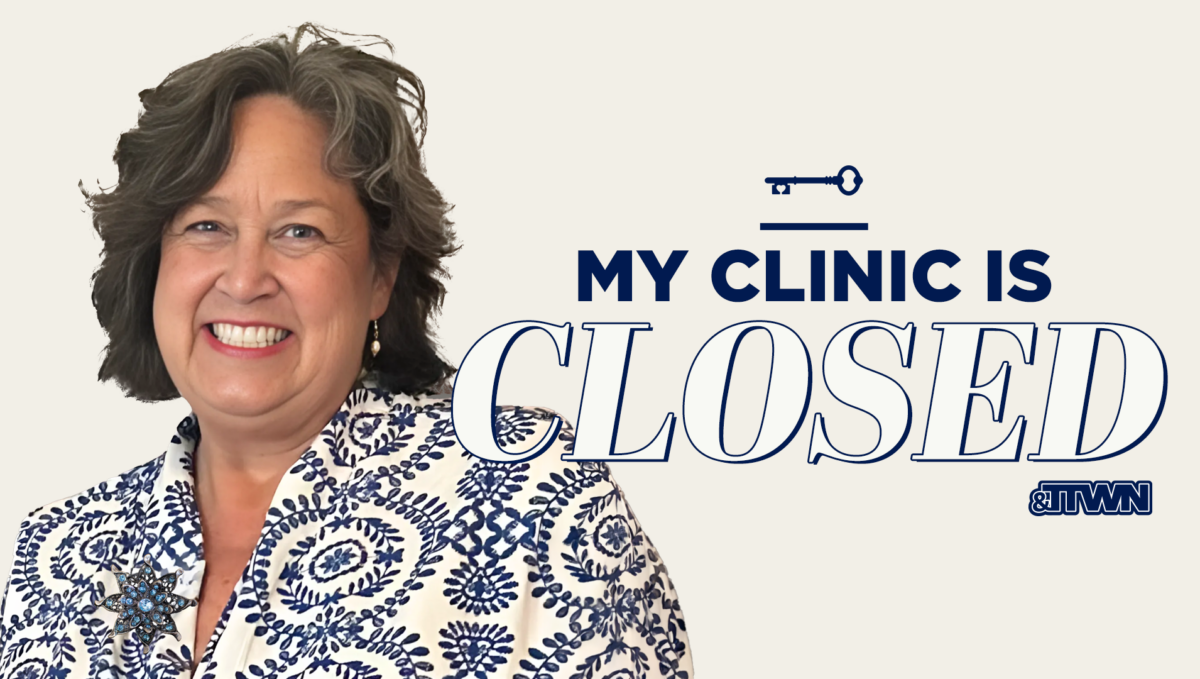
When Sarah Eubanks looks back on the building where she once had an abortion, and where she later worked, she sees more than a former employer. She sees a place where darkness once felt normal. She sees the room where her own abortion took place. She remembers the recovery area, the procedure room, the language used to hide the truth, and the women who were moved through the process without ever being offered real help.
But she also sees a closed chapter and a new life in Christ.
“I found out that my old clinic was a pro-life center named Claire’s Hope,” Sarah shared. “A pro-life family bought the building and turned it into a place to show what abortion is.”
Sarah does not remember exactly when The Ladies’ Center of Mobile, Alabama closed or the circumstances that led to its closure. But she remembers what it felt like to learn that the place where so much pain had happened was no longer an abortion facility. “I was very surprised but also very happy,” she said.
For Sarah, the closure of that clinic carried deep personal meaning. It was, in many ways, the end of a painful story she had carried for decades. “The closure solidified things for me,” Sarah said. “Almost like finishing a book, you close the back cover and you’re done.”
Sarah worked in the abortion industry for three and a half years while she was in nursing school in the 1990s. She had previously had an abortion at the same clinic where she would later work. At the time, she believed the job would give her medical experience. “I needed a job,” she said. “I was in nursing school and I thought that this would be good knowledge for me to have because I had my own abortion at the same clinic where I ended up working.”
The hiring process was shockingly casual. Sarah walked in and happened to meet the administrator at the front desk. “She offered me a job right then and there,” Sarah recalled. “She told me where to buy the scrubs and I started to work that week.” There was no application. No references. No confirmation that she was actually in school. “I just got hired and started working in the procedure room,” she said.
Although Sarah was sometimes called a “counselor,” she quickly realized there was no true counseling happening. “You didn’t really counsel anybody,” she said. “You would explain the procedure, but not thoroughly.” Women were not asked why they were there. Other options were not discussed. The language was carefully controlled. “One of the things that I remembered, it was never a baby,” Sarah said. “And I don’t think we even used the word pregnancy.”
Instead, women were moved through a system that assumed the abortion would happen. Sarah described calling women from the waiting room, giving a brief explanation, handing them a gown and a bag for their clothes, and then leading them toward the procedure room. “You were going to lock in with them having an abortion,” she said.
Sarah’s first day in the clinic placed her directly in the procedure room. The doctor, knowing she was in nursing school, wanted her to learn. He had her kneel beside him so she could see everything. She handed him instruments and turned on the suction machine. When the machine started, everything changed. “It was just the most horrific sound,” Sarah said. “When I saw blood going through there and tissue going through there, I internally was freaking out.”
But outwardly, she stayed composed. She believed she had to. “I couldn’t say anything externally because I’m in the medical field,” she said. “This is a medical procedure.” Though Sarah had grown up in a Christian household, at that time she had separated herself from the foundation of faith she had been given. “God was nowhere near my life at that time,” she said. “But I remember looking up at the ceiling and asking God to help me get through this abortion.”
She got through that procedure. Then she helped the woman clean up, walked her to recovery, cleaned the room, and brought in the next patient. “And then it was just boom, boom, boom, boom, boom the rest of the day,” she said.
During her time in the clinic, Sarah believed she was helping women. She was calm. She held hands. She told women they would be okay. When they asked if it would hurt, she reassured them. But there were things she never said. “I never once told them that this is a baby,” Sarah said. “This is how far along you are.”
Even after the procedure, when staff examined what they called “tissue,” women were not told what had been found. “You never told them that they just aborted twins or triplets,” she said. “It was just this hush hush.”
One moment in particular stayed with Sarah. In the lab, she had to piece together the remains of twins. Her brothers are twins, and the reality of what she was seeing hit her hard. “I started thinking that this is what my brothers would look like,” she said. “But I had to snap out of it.”
At the time, Sarah did not leave because she had a change of heart about abortion. She left after conflict at the clinic made her feel pushed out of the “family” she thought she had there. She remained pro-choice when she walked away. But God was not finished with Sarah’s story.
Years later, after Sarah began her healing journey, she was connected with Claire’s Hope — the pro-life organization that had taken over the building where her former clinic had operated. After her first weekend of Surrendering the Secret, a Bible study and healing program for women with abortion wounds, the facilitator arranged for Sarah to tour the old clinic building. Walking back inside was devastating.
“That first time in was SO HARD,” Sarah said. “I walked into the room where I had my abortion and bawled my eyes out.” Some of the building was still painfully familiar. “The carpet in recovery was the same,” she recalled, “even had blood splotches on it.”
For Sarah, the building held memories of her own abortion, her years working in the industry, and the women she had helped lead through abortions. Seeing that same building no longer operating as an abortion clinic brought relief, grief, and closure all at once.
Knowing the clinic had closed did not erase the past. It did not change what had happened there. But it became a sign that God could bring an ending to places and seasons that once seemed consumed by darkness.
Sarah was not a Christian when she left the clinic. Her heart had not yet changed. But in 2001, shortly after 9/11, a friend invited her to a Wednesday night Bible study at church on the seven deadly sins. “I said, ‘Yeah, I’ll go — to make sure I’m doing them all right,’” Sarah said.
That Bible study became the beginning of a slow return to God. Sarah bought a new Bible and began digging in. At first, she was drawn to the historical parts of Scripture. Over time, she began to encounter the miraculous God behind it all. “God has softened my heart,” she said.
Still, Sarah carried guilt and shame from her own abortion and from her work in the clinic. For years, very few people knew her full story. “I had accepted God’s forgiveness a long time before all of that,” Sarah said. “But I just couldn’t forgive myself.”
Through Surrendering the Secret, Sarah began confronting the pain of her abortion. Then she learned about Abby Johnson and realized there were others who had left the abortion industry too. “I didn’t know there were people like me out there,” Sarah said. “Somebody else gets it.”
That connection eventually led her to And Then There Were None. In September 2014, Sarah attended her first healing retreat with ATTWN. “That was life changing for me,” she said.
Through retreats, counseling, community, and the support of other former abortion workers, Sarah began to heal not only from her abortion and clinic work, but from other wounds in her life as well. “There are people that understand me even when I don’t understand myself,” she said.
For Sarah, ATTWN became a place where truth and love worked together. “They love you without judgment,” she said. “That doesn’t mean they won’t put you in your place, but they do it with love.”
Today, Sarah’s life looks very different from the years she spent in the abortion industry. “I live for The Lord,” she said. “I’m drug free. I’m happy — on the inside, not just a fake happy, but true joy which only comes from The Lord.”
Sarah describes her healing journey as something that has changed every part of her life. She has found her voice. She has grown stronger. She is learning to live with joy, discipline, courage, and faith. “I feel like I am finally becoming the Christian soldier that God has created me to be,” she said. “God has made me fierce. God has given me spunk and sass, and now I’m able to use it to fight for good and to fight for life.”
Sarah has also seen God use her story in ways she never expected. She has spoken publicly, appeared in pro-life projects, and even had the opportunity to speak at the Mobile Alabama March for Life. There, she publicly asked forgiveness from anyone who may have been one of her patients during her time in the clinic. “That was big,” she said. “I don’t know if anybody heard it, but I know God’s going to put the people there that needed to hear that.”
Sarah knows her past is painful. But she also knows it is not wasted. “God uses our mess for His messages,” she said. “Everything bad that we do, God can turn around.”
Because Sarah once worked inside the abortion industry, she understands the mindset of those who are still there. She does not see abortion workers as monsters. “They’re not monsters,” she said. “They’re lost.”
Sarah believes many abortion workers are wounded people who think they are helping. Many, like her, have been hurt by abortion themselves or carry trauma they have never faced. “They think what they’re doing is right,” she said.
Her message to them is simple and full of compassion: “Let us help you.”
Sarah wants abortion workers to know they do not have to stay where they are. They are allowed to change their minds. They are allowed to admit that abortion is not the answer. They are allowed to leave. “The moms are in a dark place and need your help,” Sarah said, “and abortion is not the answer.”
She also wants them to see the humanity of the child. “The tissue that you talk about is a baby and has a soul that only God can create,” she said. “Even if you don’t believe in God, please look at the humanity side of it.”
And for those who feel trapped by guilt, shame, or fear, Sarah offers the hope she has found in Christ. “No sin is too big for God to forgive,” she said.
The clinic where Sarah once had her abortion and later worked eventually closed. For a time, it became a place dedicated to revealing the truth about abortion. Later, the building was sold and became another business. But for Sarah, the significance remains.
Sarah’s life is no longer defined by what happened there. Where there was once secrecy, Sarah now speaks truth. Where there was once shame, she now walks in forgiveness. Where there was once darkness, she now lives in the joy of the Lord.
“There have been times in my life that I saw the depths of hell and I danced with the devil,” Sarah said. “But here I am now dancing in the sun and singing God’s praises.”
Sarah’s story is a reminder that God can redeem any past, close any chapter, and bring life out of places marked by death. Her hope is that someone will hear her testimony and believe a better life is possible.
“That someone will see themselves and want to do better, be better, and have a better life,” she said. “My life is far from perfect, but I have HOPE that only God can give.”